
The short answer
A ductless mini-split is a good fit when certain rooms stay too hot or cold, your home has no ductwork, or you want efficient heating and cooling from one system. We assess your rooms, electrical capacity, and equipment placement, then lay out repair, replacement, or add-on options so you can choose what fits your home and budget.
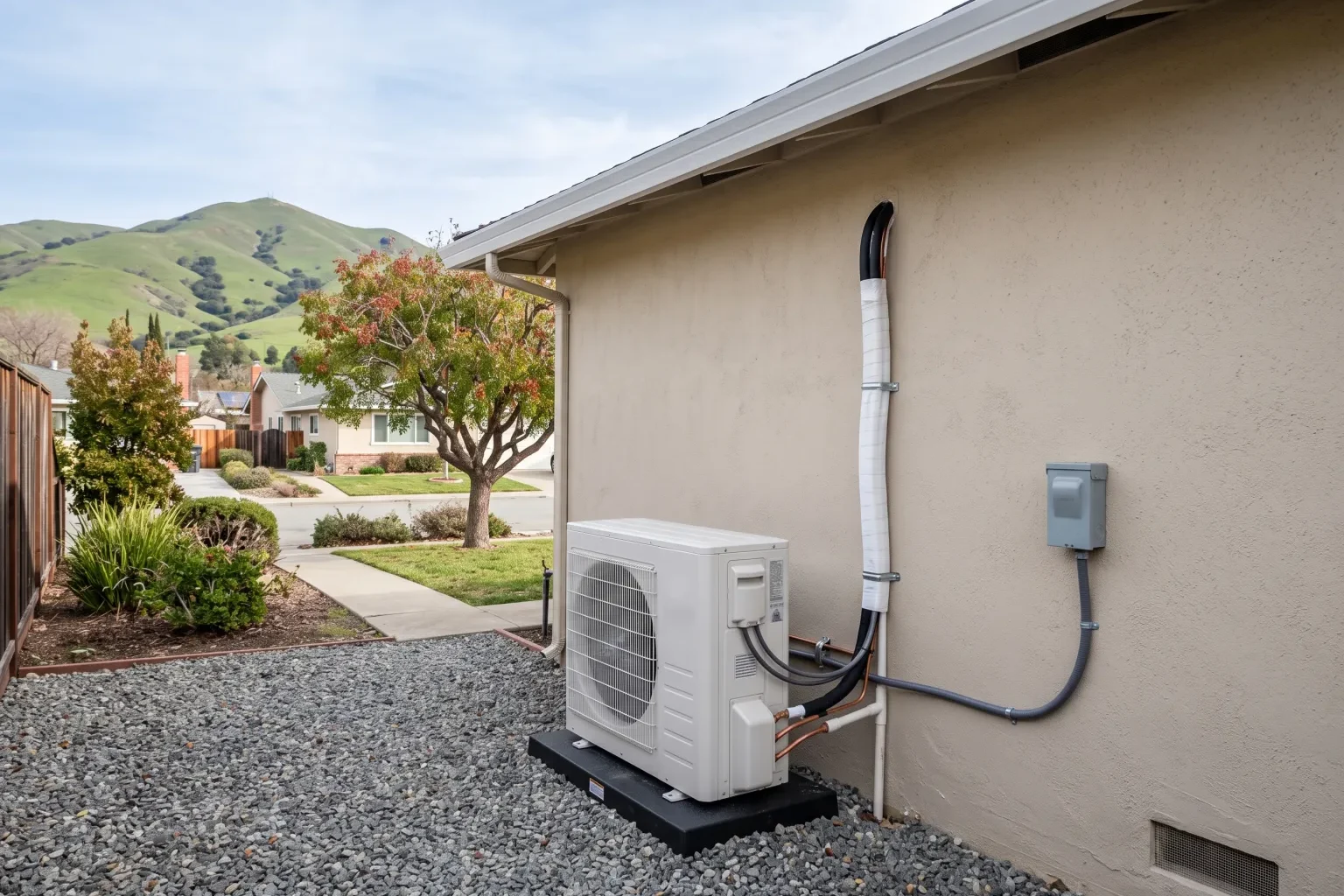
A ductless mini-split heats and cools a home without ductwork. An outdoor unit connects to one or more indoor units, called heads, through a small bundle of refrigerant lines and wiring that passes through a hole in the wall a few inches across. For homes in Fremont, Newark, Union City, and Milpitas, a mini-split is often a practical way to cool a hot upstairs bedroom, condition an addition or garage conversion, or replace an aging wall furnace. This page explains when a mini-split makes sense, what we look at before recommending one, how it compares with repairing what you already have, what drives the cost, and what to expect when a technician comes out.
Signs a Mini-Split Might Be Right for Your Home
The South Bay has a Mediterranean climate with dry summers and mild, damp winters. Because of that, many older homes in the area were built without central air. That works fine most of the year. Then a hot stretch arrives and the upstairs or west-facing rooms become hard to sleep in. In the nearby Santa Clara Valley, inland and southern areas run noticeably hotter in summer than areas near the Bay. If your home sits farther from the water, you have probably felt that difference yourself.
A mini-split is worth considering if any of these sound familiar:
- One or two rooms stay much hotter or colder than the rest of the house.
- Your home has no ductwork, or the existing ducts would need major work to reach the rooms you want to condition.
- You have added living space, such as an addition, ADU, converted garage, or finished attic.
- You rely on window units or portable air conditioners that are loud, block light, or don't keep up.
- You heat with an older wall or floor furnace and want a cleaner, more even source of heat.
- You want one system that both heats and cools.
- People in your household want different temperatures in different rooms.
What We Check Before Recommending a System
A mini-split only performs well if it is sized and placed correctly. A unit that is too large cycles on and off and leaves rooms clammy. A unit that is too small runs constantly on hot days. Before we recommend equipment, we look at the specific rooms and the house as a whole.
Our assessment covers:
- Room size, ceiling height, insulation, windows, and how much afternoon sun each room gets.
- How each room is used, such as a bedroom, home office, kitchen, or living area.
- Your electrical panel's capacity and whether a dedicated circuit is available.
- Where the outdoor unit can go, with attention to airflow clearance, noise near bedrooms or neighbors, and drainage.
- The route for the refrigerant lines and wiring, and the type of wall construction they will pass through.
- A clear path for the condensate drain so water from the indoor head is carried away properly.
- The age and condition of any existing heating or cooling equipment.
Repair, Replace, or Add On: Your Options
Not every comfort problem calls for a new system. If you already have a mini-split that isn't cooling or heating well, the problem may be a refrigerant leak, a clogged drain, a failed sensor, a dirty coil, or a control board issue. Many of those can be repaired. If the system is older, needs repeated repairs, or no longer matches how you use the space, replacement may make more sense. We will explain what we find and give you both paths when both are reasonable. If a system fails at a bad time, we offer 24/7 emergency service.
If your home has a working furnace or central air conditioner, you do not have to remove it. The Bay Area Air District appliance rules do not require replacing working equipment. They apply only when an existing furnace or water heater fails or is replaced. Planning ahead still helps. Under the Air District's Rule 9-4, natural gas furnaces manufactured from 2029 must meet a zero-NOx emission standard. In practice, that points homeowners toward heat pumps when a furnace is replaced after that date. A mini-split is a type of heat pump, so it can be part of that plan.
Common options include:
- Repairing an existing mini-split.
- Replacing one indoor head or the full system.
- Adding a mini-split to cover rooms your central system doesn't reach well.
- Replacing a wall furnace or space heater with a heat pump mini-split.
What Affects the Cost
Every installation is different, so we quote after seeing the home. These are the main factors:
- The number of indoor heads and separate zones.
- The style of indoor unit: wall-mounted, ceiling cassette, slim ducted, or floor console.
- The heating and cooling capacity each room needs.
- The equipment's efficiency rating.
- The length and difficulty of the line set route, including runs through multiple floors or finished walls.
- Electrical work, which can range from adding a circuit to upgrading the panel.
- How the outdoor unit is mounted, such as on a ground pad or a wall bracket.
- Any permits required for the project.
- Removal of old equipment, if any.
How a Visit Works
First, you contact us and describe the rooms you want to heat or cool and any problems you have noticed. We schedule a time for a technician to come to your home.
At the visit, the technician walks through the house, takes measurements, checks your electrical panel, and looks at possible locations for indoor and outdoor units. Bring up anything that matters to you, such as where you'd prefer the head not to be visible or concerns about noise near a bedroom window.
After the visit, you get a written proposal. Where it makes sense, it includes more than one option, such as a single-zone or multi-zone setup, or a repair compared with a replacement. We will also tell you whether a permit is needed.
On installation day, the crew mounts the indoor and outdoor units, runs and seals the lines, connects power and the condensate drain, and tests the system. Before we leave, we show you how to use the remote, set schedules, and clean the indoor filters.